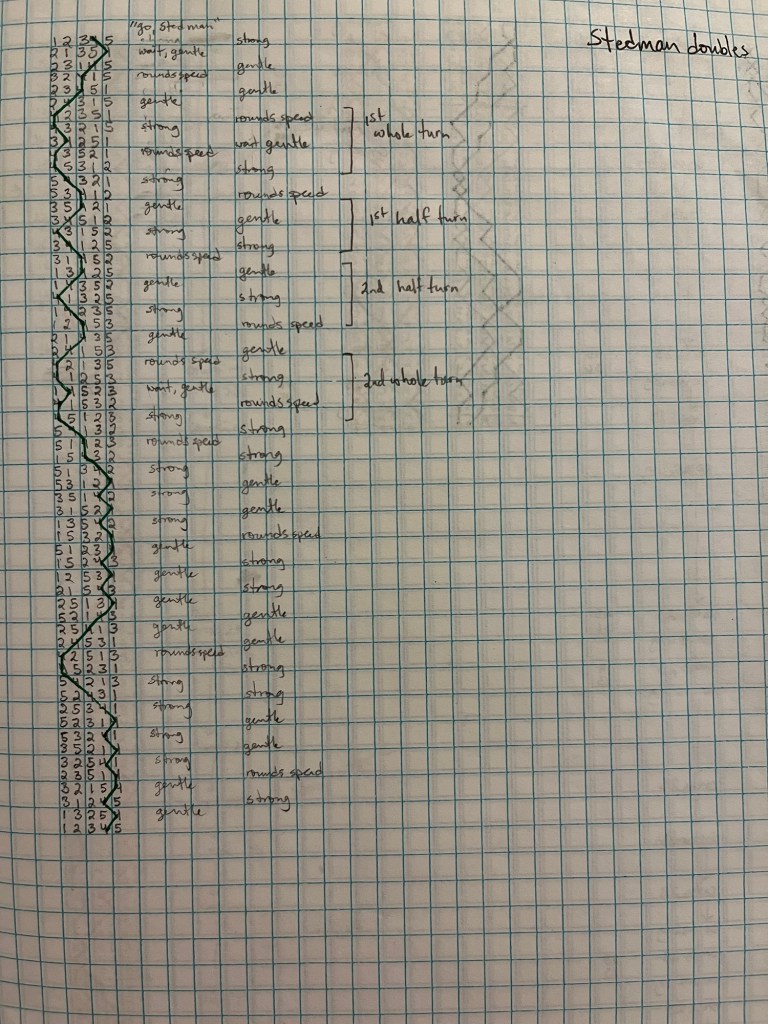
An important part of ringing efficiently, ringing without tiring yourself out, is translating the abstract idea of a method into what to actually do physically. The photo above shows a page of my first ringing notebook where I wrote out a plain course of Stedman Doubles, drew a line through the 4, then wrote how to pull every single blow on the 4.
There are basically three options for how to pull: strong, gentle, and rounds speed. How different these are will depend on the tower, the band, and the specific bell. I’ve also included “wait” for some of the rows—this is basically for bells small enough that ringing to the balance won’t be slow enough and waiting a moment at the balance point might sometimes be necessary. Note also that “strong” and “gentle” are relative to the rounds speed for a particular bell—you may not need an actually strong pull, just one slightly stronger than what you need to stay in rounds. And “strong” on a handstroke may be very different from “strong” on a backstroke. (In the photo, the left column of words is how to pull that handstroke and the right column is how to pull that backstroke.)
How much to pull NOW depends not on what your current place is, but on the relationship between your current place and your place in the next row. If you will be in the same place in the next row, your current pull should be your rounds speed pull, regardless of what place you’re in. If your next place is later, pull this blow strong. If your next place is earlier, pull this blow gently.
I know the reality of ringing is more complicated than this, but it’s a really good place to start. If you’re controlling your place by simply overpulling and resisting the rope on its way up, or yanking it down to ring earlier, you’ll get tired much faster and struggle with heavier bells that won’t respond well to yanking. Pulling each stroke to set up the next place greatly reduces the need for resisting the rope.
One of the dangers of thinking ahead in ringing is that you might start doing the upcoming thing that you’re thinking about, rather than what you’re supposed to do right now. But the kind of thinking ahead I’m talking about here is supposed to affect what you do right now. Perhaps it’s not so much thinking ahead as thinking of each blow as a connection between two places, rather than a point in one place. The places I ring in might go “4 5 4 3” but the pulls will go “4 to 5 [strong], 5 to 4 [gentle], 4 to 3 [gentle]”.
The main complicating factor in this is that the lower a bell is, the stronger a pull it will need to stay in rounds, much less hunt up. This is why the strong pull in a dodge down probably needs to be stronger than the strong pulls used when hunting up. And the gentle pull in a dodge up can probably be much gentler than the gentle pulls for hunting down. In fact, in many contexts hunting up only needs one strong pull—the pull that gets you into hunting up speed. The rest can be gentle, because when the bell is swinging higher, gravity will do more work for you. Similarly, when hunting down, particularly on a heavy bell, the pull that gets you to a faster speed can be very gentle but the rest may actually need to be strong to keep the bell from dropping any further.
It would probably be overkill to write out how to pull for every blow of every method you learn, as I did for Stedman Doubles in the photo. But I think it is a valuable exercise to do at least once, to try to get in the habit of thinking this way and pulling efficiently. It can be especially useful when learning a method that is very different from others you’ve done before—that’s why I did this for Stedman! Because Stedman includes some wrong hunting (you can see my explanation of Stedman here), the habits I’d developed for Plain Bob and Grandsire didn’t always serve me. It was very helpful to think through precisely what I’d need to do differently to ring Stedman well.
 Among Sallies and Bobs