Say you’re doing archery, shooting arrows at a target. Naturally you’ll aim at the center, since that’s where you want to hit the target!
After you’ve fired your round of arrows though, it turns out they’re all *above* the center. Aiming at the center is pretty reliably getting your arrows…not in the center.
So, try aiming lower.
If you aim lower than before and start hitting the center, you might then mentally reframe what you’re doing as “aiming at the center”. You thought you started out aiming at the center, but actually you were aiming too high. You had a goal—hit the center—and then had to learn what physical actions were required to achieve that goal. It’s very reasonable for the first several attempts at aiming not to produce the desired results. Wanting to hit the target isn’t enough to cause you to do it, but if you can assess the results you’ve gotten, no matter how bad, you can probably bring your desires and actions into alignment.
This is a blog about bellringing.
Sometimes during a piece of ringing, I’ll tell myself that I need to pull less, and a part of me will immediately reply, “but what if I don’t pull enough??” Out of context this is a valid question and I do have answers for it, but for me personally, it’s pretty unlikely that I won’t pull enough. My response to myself in these instances is usually, “have you actually managed to be too gentle on this bell today? No? So why worry about it?”
I want to achieve the Goldilocks amount of pull—just right! But my tendency is to overshoot that, at least a little bit. I think this is a very common tendency! If you overpull a little bit, you might be able to correct it, but if you underpull at all there’s nothing you can do about it until the next stroke. I could still stand to aim a bit lower in general though, to adjust my concept of “enough” to be a little gentler.
Figuring out what your tendencies are or how your “aim” might be inaccurate can be very complicated in ringing, but I think it’s really important to try. Chances are you want to ring very well but as I said earlier, unfortunately wanting something isn’t enough to make it happen. This is one of the things that a simulator can be extremely useful for. In these days of pocket video cameras, getting video of yourself is an easily accessible way to be able to analyze things about your ringing.
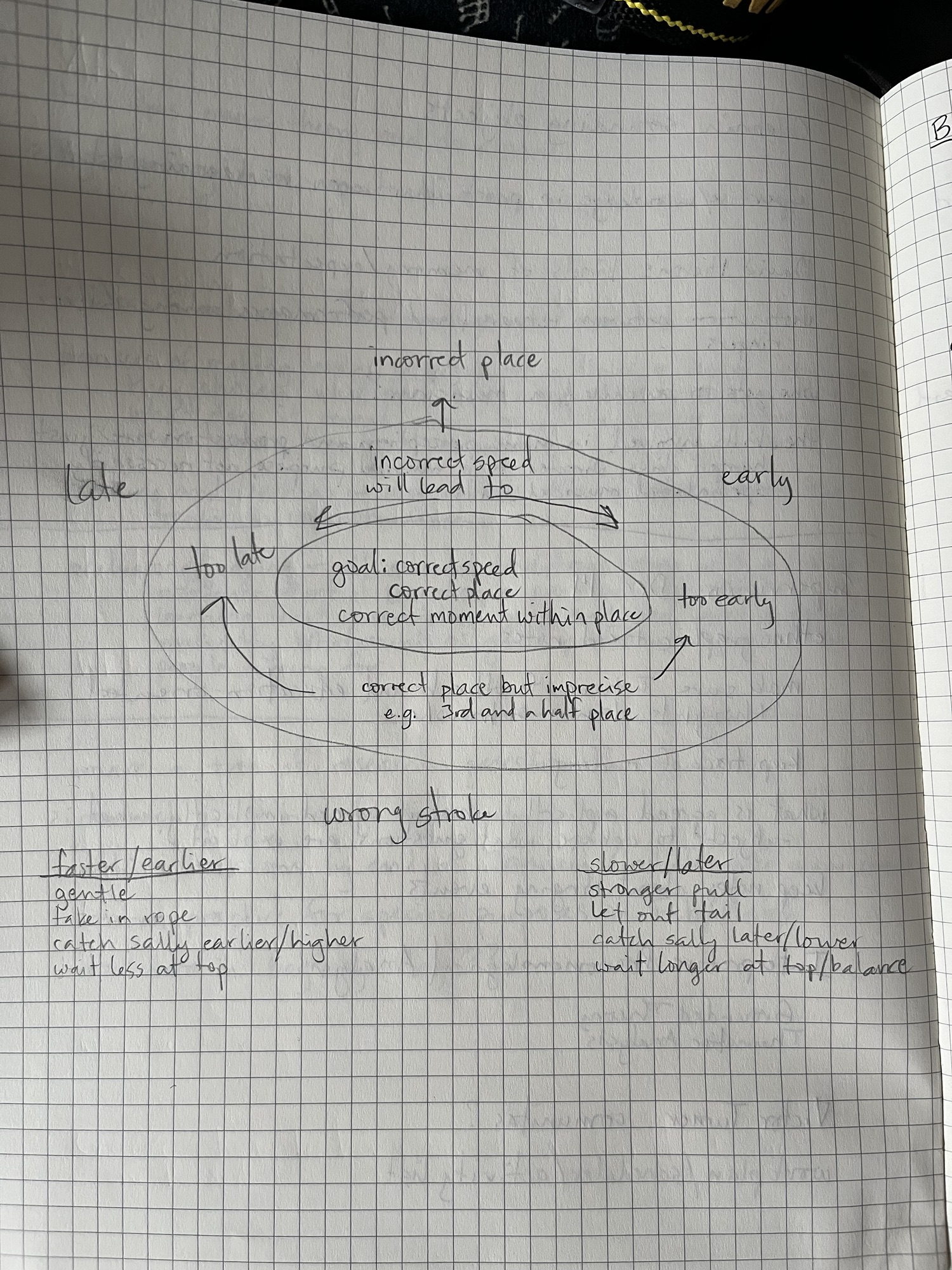
In the past year and a half, I’ve encountered a lot of beginning ringers with a tendency to resist the rope on the way up, or wait too long before letting their hands go up with the rope. This is a reasonable tendency when they’ve been told to keep the rope tight and to wait for the rope to pull their hands up! But it seems these instructions are not quite getting learners to “aim” for the right place.
A strategy I’ve tried this year is to say: I know it is not physically possible to push the rope up, but after the handstroke is finished try pushing the rope up a little bit. This has worked perfectly with almost all the learners I’ve tried it with. It turns out moving their hands up with only a small amount of tension in the rope feels to them like pushing the rope up, even though that’s not what they’re actually doing. As a teacher it may feel weird and wrong to say something like this, but I believe it is good to find the actions that produce accurate results and THEN relabel them.
So, here is a summary of how to improve your aim:
- Attempt to hit your target.
- Assess what you actually did. How is it different from what you wanted?
- Figure out how you might need to adjust your aim. If you’re not sure (and you didn’t quite hit the target), just pick something to do a little differently. It might not be right either, but it will give you more information!
- Repeat.
 Among Sallies and Bobs
One thought on “Where to aim; or, How to do what you want”